OUR APPROACH
The DNA of Coaching
Every coach we train learns a model of our own: a clear, flexible structure for how a coaching conversation actually moves. Not a script to follow, but a way of knowing where you are and what is needed next.
WHERE THE NAME COMES FROM
Two strands, stronger together
Change lies at the core of coaching. Clients arrive feeling stuck, seeking clarity or wanting to understand themselves more deeply. They are almost always in some form of transition. Yet change is rarely straightforward, and the coach is not a cheerleader but a thought partner: someone who helps the client clarify, explore and question.
The image that best captures this movement is Watson and Crick’s double helix. Two strands run alongside one another, distinct yet inseparable. Each keeps its integrity. Neither collapses into the other. Yet together they create something generative.
In coaching, the coach and the client occupy similarly distinct stances. The coach does not merge with the client’s story, nor dominate it. The client keeps authorship of their experience. Through dialogue, reflection and shared attention, two separate perspectives intertwine in a way that produces new insight and forward movement.
“Coaching is neither a linear sequence nor a set of mechanical techniques. It is a relational structure. Two strands moving in parallel, occasionally tightening, occasionally loosening, always responsive to what is unfolding. Stronger together.”
The DNA of Coaching
THE MODEL
Three phases, twelve moves
The DNA Model gives a conversation structure without imposing rigidity. Three phases describe how a coaching conversation moves. Within each phase are four core conversational moves. We say moves rather than steps deliberately, because a move can be revisited, deepened, combined or adapted as the conversation unfolds.
D
Define
From surface issue to meaningful focus
Every conversation begins somewhere. A client arrives with a topic, sometimes clear, sometimes tangled, sometimes deceptively simple. The work of this phase is not to fix the topic. It is to understand it.
MOVE 1
MOVE 2
MOVE 3
MOVE 4
N
New Insights
Expanding perspective and deepening awareness
Once the opportunity is defined, the conversation shifts from clarifying the issue to stretching the thinking around it. This is the space where assumptions are questioned, possibilities are generated, alignment is tested and a future orientation begins to take shape.
MOVE 5
MOVE 6
MOVE 7
MOVE 8
A
Apply
Translating insight into lived experience
Insight without application fades quickly. This phase translates awareness into movement, where intention becomes action and reflection becomes behaviour. Not rigid planning, but supporting the client to act in ways coherent with their identity, values and chosen direction.
MOVE 9
MOVE 10
MOVE 11
MOVE 12
WHY IT MATTERS FOR YOUR TRAINING
A named method, not a generic syllabus
Most coach training teaches an off-the-shelf model. Our programmes are built on a framework we developed and wrote the book on. That means a coherent thread runs through every module, every piece of feedback and every practice conversation.
Understanding the move
The focus and purpose of each move, with examples, reflective prompts and the common challenges coaches meet.
Putting it into practice
Practical guidance for live conversations: example questions, conversational techniques and real-world considerations.
Practice and reflection
Structured exercises that deepen self-awareness and strengthen your ability to apply each move with judgement.
Case study
A realistic scenario showing how a move unfolds in action, with insight you can adapt to your own context.
THE BOOK
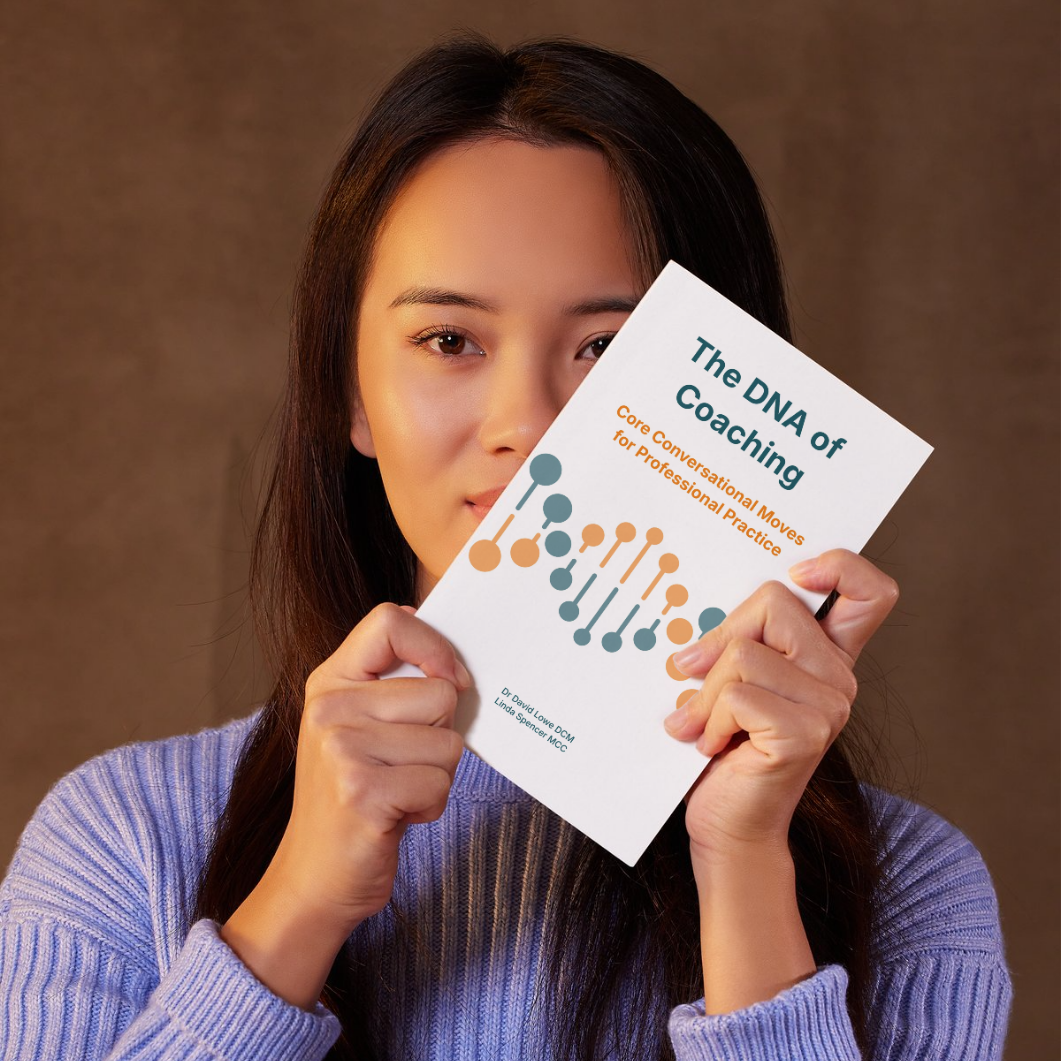
The DNA of Coaching sets out the full model: each phase, all twelve moves, with exercises and case studies throughout. It is the text behind our teaching, written for both experienced coaches honing their craft and new practitioners seeking a clear, flexible structure.
By David Lowe and Linda Spencer. Oxford, June 2026
Learn the DNA of Coaching on our programmes
The model runs all the way through the Art of Professional Coaching, our ICF-accredited training. The best way to learn it is to practise it with feedback from our faculty.